
Event overview – Interactive exhibition ‘ IZYUM Recovery’, which was held on 01.10.2024 in Kharkiv
Perhaps this is a specificity of all creative professions – to live your project all the time, unable to stop thinking about it, even after work, when people usually rest.
This is the case with our PORTAL-21 team’s project Raisin Recovery. In my personal experience as an architect, it is the most interesting in my life. Why is that?
It is very diverse, it aims not only to create an urban planning project, but also to involve the city community in its implementation, to create a sustainable adaptive model for other cities and towns. And the new space of the residential neighbourhood should be inclusive, environmentally friendly, inexpensive, and attractive to the people who will live here, as well as to all residents of Izyum. Therefore, creating such a project is not only an ambitious goal, but also a huge responsibility.
On 1 October this year, we presented the second stage in Kharkiv – a preliminary design of a residential neighbourhood. Five architects from Kharkiv worked on it – Anastasia Gulak, Kateryna Kublytska, Oksana Bai, Maksym Semenenko and Zoya Panova. The second stage of the sub-grant is international. Therefore, we were joined by specialists from Germany, with whom Anastasiia Gulak, the project curator, had established contacts in advance. These are architects from ARCHITEKTENWERKGRUPPE – Mr Andres Garcia Elzel and Mr Günter Rettenmeier -, professor of ecology Prof. Dr Christian Küpfer, and biogas equipment specialist Thomas Dori.
The event began with a minute’s silence as it was the Day of Defenders of Ukraine. We honoured the memory of the fallen soldiers, thanks to whom we, the living, have the opportunity to dream about the future and create projects for it.
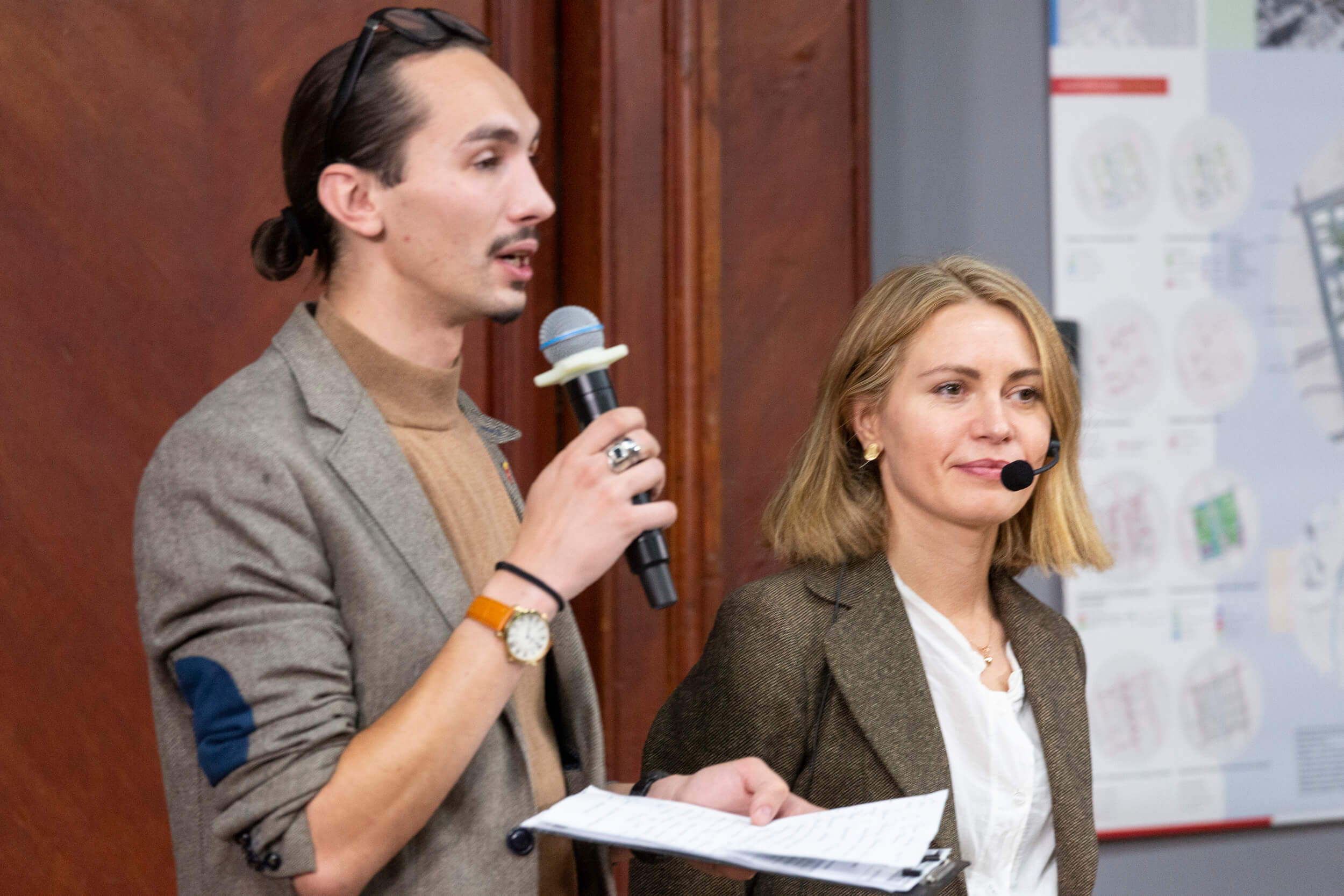
Anastasia Gulak presented the new stage of the project to the audience, recalled the history of the city, and then Maksym Semenenko spoke about a new approach to planning the quarter, which will take into account the needs of all segments of the population for unimpeded access to housing and public facilities, where, unlike in Soviet times, there are areas and premises for communication. The masterplan also envisages the reconstruction of Soborna Street, which divides the residential quarter into two parts. New bicycle lanes and a boulevard instead of a road are envisaged. Attention in the new neighbourhood layout was paid to protective structures, which currently do not exist.
◦Logically, Anastasia Gulak then spoke about the project of a new public HUB on the site of an old building destroyed by the russians at 20 Soborna Street, which was once a centre of attraction for Izyum residents and had its own special history.
Next, Oksana Bay and I, along with our colleagues from Germany, talked about the preliminary designs of residential buildings, in which we propose to build superstructures and attached lifts or attached staircases. We have also offered apartment owners redevelopment plans that include enlarging bathrooms and combining kitchens with living rooms into a single apartment, but this is, of course, at their own discretion.
Maksym Semenenko presented a very interesting project of low-rise social housing. In general, all projects of multi-storey buildings were common in taking into account the needs of IDPs, protection from shelling (for this purpose, safety rooms are provided), and the installation of environmental equipment such as solar panels and biogas plants. We also tried to make them attractive in appearance to get rid of the monotony and dullness of the Soviet era.
It was very important in the project to tell the story of the creation of a public organisation that would help unite all those who care and attract investment for social purposes. The leaders of the new NGO ‘Izyum Recovery’ were Anastasia Gulak and Oleksiy Nesterenko, an active citizen and entrepreneur from Izyum, who helped our team a lot in creating the project. It should be noted that the city leaders also demonstrated their interest in this project by both attending the event in Kharkiv and providing real help. These are the deputy mayors of Izyum, Mykhailo Ishchuk and Volodymyr Matsokin, and the chief architect, Serhii Belichenko, who helped very actively with the initial data.
So, we hope that by joining forces, we can all make the Izyum Recovery project not a dream but a reality.
The article was prepared by architect Zoya Panova